Saturday, May 18, 2019

Sucre - A UNESCO City

Google Maps would have you believe that Bolivia F6, the road that connects Oruro to Sucre, doesn't in fact exist, or at least there is a gap of 100 miles between two stub ends. It turns out F6 not only exists but is a cracking road over the central highlands, revealing a landscape I had not previously associated with Bolivia.

After navigating through the mining town of Huanuni the views became increasingly more engaging with some interesting rock formations in places.


More from the road in the video.


Hostal Solariega, in Sucre, is a world apart from the misery of the Oruro residencia. A delightful courtyard setting, close to the center of this UNESCO world heritage city. The accommodation and city center have an upmarket and wealthy feel, quite distinct from the areas visited in La Paz. The place hums with young people, mostly Bolivians supplemented by many tourists.


Originally named La Plata by the Spaniards for the rich deposits of silver in the area, the city was renamed in honor of General Sucre, a Venezuelan,  who was instrumental in the fight for Bolivian independence achieved in 1825. Old Sucre is a white city (not unlike Popayan) and was the seat of government for decades; it remains the constitutional capital of Bolivia.


The Casa de Libertad, the first meeting place of the Bolivian congress, is now a museum celebrating the birth of the country. During the morning some form of civic ceremony took place in front of the Casa de Libertad, with much military pageantry. Quite the spectacle as seen in the video which concludes with pictures from within the museum. 


The return to barracks for the grunts who had stood out in the sun in serge coats for a couple of hours was not so special. Canned sardines have more wiggle room!

Between the morning ceremonies and the afternoon visit to the museum I caught up with a couple of Brit moto travelers. Next month Steve and Janette will have been on the road in the Americas for five years, with a few short intermissions to return to the UK. Riding a Triumph Tiger 800XT they have covered 53,000 miles so far. Steve leaves a breadcrumb trail on their blog which I have checked into periodically over the years of my planning. Last week I saw they were in the area, made contact and we connected in Sucre for a most enjoyable, interesting and extended 3+ hour lunch. The possibility exists our paths may cross again, we both plan on being in Patagonia in October/November.

Safe onward travels Steve and Janette!


Cheers, T2


Thursday, May 16, 2019

La Paz, the city, Valle de la Luna and south.

La Paz has its own signature compared to Bogota, Quito and Lima. Spanish colonial architecture and the Catholic church do not feature as strongly, local traditions not elbowed out quite as fiercely. Then there is the Teleferico mass transit cable car system, uniquely suited to La Paz, situated in a valley surrounded by saw toothed mountains.

I opted to take a 3hr walking tour that started in San Pedro Square, on one side of which sits a prison. It turns out the felons pay to be in that prison where they buy or rent a cell, open businesses, restaurants and enjoy free access for their families. It is a city unto itself with different quality of barrios within. No guards patrol inside, the governance is undertaken by an organization of felons. So strong is the governing structure that Coca-Cola have negotiated  an exclusive supply arrangement. You couldn't make this story up.

A visit to the witches market, replete with llama calves and fetus used in traditional ceremonies (we were told that these were supplied from naturally occurring deaths during the harsh winters - just for the vegetarians to feel more comfortable perhaps). A visit to San Francisco church, which was quite impressive but not of the splendor of others. It includes local iconography in the external decorations as a way to induce the local population to attend, though it worked with mixed results apparently.


The main avenue is divided by a wide central pedestrian area, well maintained with ample seating; a pleasure to walk along. Of course there is the Teleferico, I used the purple line, opened in 2018 and one of 16 connected lines currently in operation with 3 more planned. Efficient and inexpensive to use (50 cents per ride), offering panoramic views of this vast city.


I had been in two minds about visiting and fighting through the traffic, known to be cripplingly heavy. In truth the traffic wasn't so bad and it was definitely worth the effort.

Leaving the city on Wednesday to head the 140 miles south to Oruro I had time to take a side trip to Valle de la Luna, an area about 11 miles south east of La Paz. The hoodoos at the valley park reminded me of Bryce Canyon in Utah, though without the vivid colors. It was easy to understand why people from the city come out to the valle at weekends and also why it is home to the La Paz golf club. Captured in the video below.


The road to Oruro is pretty much arrow straight, running through the scrubland of the altiplano. A few hills add interest, but the real action for the first 40 miles was in the rear view mirrors, which reflected the snow-capped mountains that frame the north and east of La Paz.

Oruro is a city that is undergoing a lot of urban development at it's fringes. A working, not a tourist city, it does boast a lot of artwork;  paintings, murals and sculptures on the many wide streets that are divided by pedestrian areas. 


There was a large railyard near my accommodation, which naturally I wandered over to take a look at. It was hard to know if the facility was in use when a diesel locomotive roared into life behind the walls, the gates opened and it emerged, briefly, and then returned behind closed doors.


I remain uncertain if it was just a couple of guys having some fun or there was indeed a purpose behind the movement.

Using Booking.com I opted for a room in a residencia, not really knowing what a residencia was. I know now; it is the kind of place that you don't want to book yourself into! The facilities were less than desirable or could have reasonably been expected from the online description. Anyway, lesson learned.

This post is being typed in Sucre where I arrived from Oruro this afternoon. A much nicer lodging experience here, in fact one of the best so far, such is life.  

Cheers T2


Wednesday, May 15, 2019

La Paz

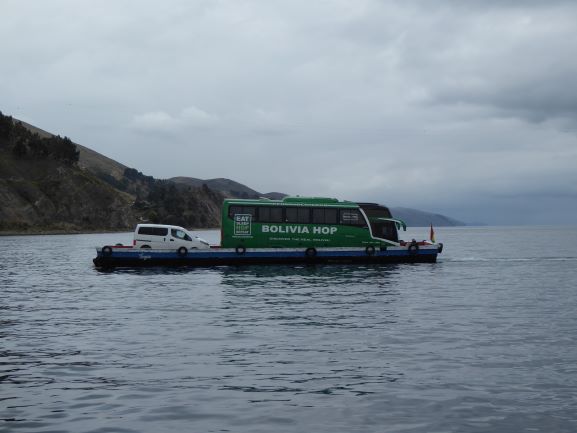
To  fastest way to La Paz from Copacabana (and which does not require going back into Peru) is to take a ferry across the Tiquina Strait, the narrowest part of Lake Titicaca that separates west and east Bolivia. To be honest it had been causing a tinge of anxiety as other moto travelers before me reported challenges managing their motorcycles on the ferry. Wooden decking missing from the center of the ferry meant not being able to turn around, necessitating pushing the loaded bike uphill and running backwards on uneven wooden ramps to get the thing off. Hard work for a gringo at 12,600ft. My anxiety was for naught.

Yesterday, while recovering a hidden money stash on the bike, I located some better pressure sensitive tape. With the camera mount reattached I choose to shoot video on the 25 mile ride to the ferry. It was a cold, dreek (as the Scots say) day with light snow at elevation. Though try as Mother Nature might she just couldn't spoil the enjoyment of this brief trip. Take a look.


Happy to be on the ferry. These vessels, as rickety as they may appear be to the western eye, are real work horses.


Sometimes photobombing just works out.


It is a further 60 miles to La Paz once disembarked and the first 20 miles of road was witness to a lot of  construction. All that was left behind on joining the 4 lane divided highway leading into the outskirts of La Paz. Taking advantage of the blazingly fast internet at the San Sebastian hotel, how about completing the ride from the ferry to La Paz?


The snow capped Bolivian Andes are stunning.


I stopped for battered and fried trout for lunch just after making the turn at the end of the video. Decent and a stones throw to the hotel in El Alto,  a suburb of La Paz.


A quick change and off out to take a look around, a few blocks later my first view of the center of Bolivia's capital city.


A new city to explore!

Cheers. T2

Tuesday, May 14, 2019

Copacabana and Isle del Sol

Arriving in a new country isn't official until a flag sticker is applied. There, official now!

Copacabana welcomes more tourists from La Paz at the weekends, the main square was bus central. Parking spaces are scarce. It is as well the town has little traffic, otherwise it would be a cacophony of  horns.


There are a few interesting buildings in town, the most remarkable is the church which is quite grand for such a small town. Unlike many churches in Peru this one has been meticulously maintained, paint was being applied to the wall on the day I visited. The doors were intricately carved. Tomorrow will tell whether it used anymore diligently. Pleasant shop lined streets led down to the lake.


For a landlocked country (from the late 1800's anyway) it was surprising to find a Bolivian Naval Station. I am hard pressed to understand what they do, perhaps the navy is simply related to national pride. After a tough day in the office taxing myself on the navy question a chilled beer was called for, Bolivian of course.


A video sweep of the bay. (A small raw video clip is all that the WiFi can swallow here!)


A pasta dinner on the main tourist street, which was decent, preceded by a nice evening moonscape.


The Isle del Sol, an island north of Copacabana, did not seem likely to live up to the name. My ticket was for the 8.30am sailing, it had been storming all night and I awoke to heavy rain and hailstones coming down.

It had not brightened by the time of departure, the lake was running a 3-4ft swell, the rain continued and briefly turned to snow. The Bolivian tour guide seated next to me proclaimed that in his 20 years of coming to Lake Titicaca it had never rained, let alone snowed and the water should be like a sheet of glass. So much for that.

The poor man with his boot on the tiller was not equipped with the best foul weather gear I have ever seen.

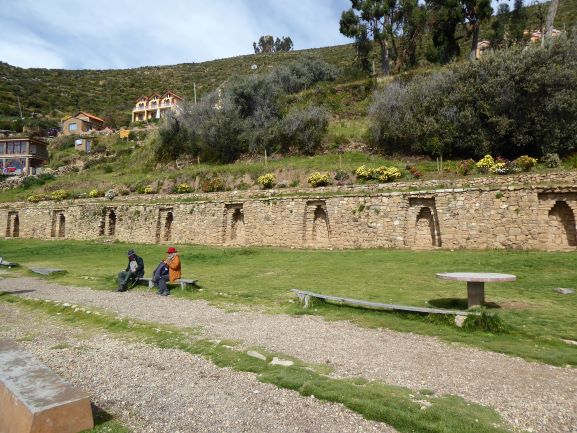
The wretched start to the day was over with by the time we reached Isle del Sol. The island revealed it's secrets under a partly sunny sky. The ceremonial alters, the 'Fuente de Inca' - a water source and the Pilkokaina Palace, all  surrounded by the breathtaking lake.


Isle del Sol is paired with Isle de la Luna, seen through one of the portals in the Palace.


Not of the grandeur of Pisac, but Pisac didn't have these views. The Inca terraces are still used in places, an excellent crop of broad beans (fava beans for Americans) just below my table. All I really wanted for lunch was a plate of those, freshly picked, boiled and slathered in butter, salt and pepper. Heaven would have been complete. Not on the menu, so instead I had a chicken sandwich.


I couldn't resist taking a picture of another black burro, separated at birth? I think not.

Back to the harbor for return where I spotted a couple of traditional reed boats tied up and behind them in the distance the snow covered Bolivian Andes,


Finally a couple of people photos taken during the day. The first of a very young local girl who after taking the photo put her head in her lap and told me not too. I was going to delete it until I met her mother a little way up the path who asked if I wanted a photo, for a fee of course, so I kept the girl's photo figuring I wasn't taking too much of her soul. 

The older, not so local threesome, hail from the UK. Recent grads not liking the work scene so they quit jobs to travel for 4 months. Good for them. We bumped into each other during the course of the day. The father of the  girl at right is an avid motorcyclist apparently. They were more willing photo subjects than the local, no fee asked or paid! 


Onward to La Paz.

T2